Showing posts with label US unemployment. Show all posts

Tuesday, June 19, 2012

Poverty and inequality: the real State of the Union

As the leaders of the major economies gather for crisis talks in at the G20 in Mexico, they’ll be pondering how they can save capitalism from itself. What they won’t be doing is addressing the vast inequalities that have developed in countries like the United States.

While president Barack Obama and his Republican opponent Mitt Romney trade insults and accusations, neither will refer too often to the real State of the Union. Here, for your enlightenment, are some basic facts about a country usually described as the world’s richest nation:

Poverty: The US poverty rate is estimated at 16.0% of the population. The Department of Agriculture estimates that 14.5% of all households were "food insecure" in 2010.  

UnemploymentUS unemployment is officially 8.2%. The employment-to-population ratio is nearly 5% lower than just five years ago. Anywhere between 10 and 15 million Americans are out of work.  

Discouraged workers. Discouraged workers are persons not currently looking for work because they believe that there are no jobs available for them. The unemployment rate that counts discouraged workers has soared to 15% of the workforce.

Income inequality: The US ranks third among all the advanced economies in the amount of income inequality. The top 1% of Americans control nearly a quarter of all the country's income, the highest share controlled by the top 1% since 1928.

Chief executive officers in 1965 made 24 times more than the average production worker, whereas in 2009 they made 185 times more, falling from a peak of 300 times in 2000.
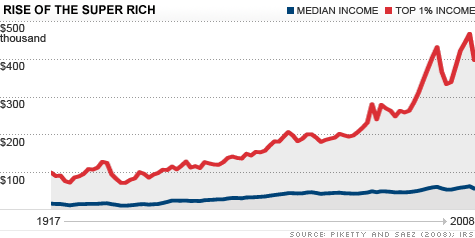
income inequality
The median value of family income, when adjusted for inflation and before taxes, fell by 7.7% — from $49,600 in 2007 to $45,800 in 2010.

Racial gaps in education. High-school drop-out rates are least among whites and highest among Hispanics, while college enrolment rates are least among blacks and highest among whites.  

Child Poverty. In the United States, 21% of all children are in poverty, a poverty rate higher than what prevails in virtually all other rich nations.

Health insurance. In 2007, 8.1 million children under 18 years old were without health insurance. Children in poverty and Hispanic children were more likely to be uninsured.

“Bad jobs”. About 10% of full-time workers are in low-wage jobs, 30% don't have health insurance, and 40% don't have pensions.  

Wealth inequality. Ownership of wealth among households in the US has become more concentrated since the 1980s. The top 10% of households controlled 68.2% of the total wealth in 1983 and 73.1% of the total wealth in 2007.


Deregulation of the labour market. The percentage all wage and salary workers who are union members has declined from 24% in 1973 to 12.4% in 2008. At the same time, the real value of the minimum wage, which fell by 25% in the 1980s, has not recovered.

Incarceration. The incarceration rate in the United States has grown dramatically since the 1970s and the US now has one of the highest rates in the world. A full 37% of those who are both young black males and high school dropouts are now in prison or jail, a rate that's more than three times higher than in 1980.

In November, the half of America that votes in presidential elections will be presented with a “choice” between Romney, whose net worth is estimated at $200 million and would undoubtedly widen inequality, and Obama who has appeased the rich and watched inequality grow since he took office in 2008.  

For a system that claims it is based on competition and choice, there is really none at all when it comes to the ballot box.

Paul Feldman
Communications editor


Thursday, October 15, 2009

Jobless youth turn to the army

You see them on trains in North Yorkshire, fresh-faced teenagers struggling with massive kit-bags. Only they are not off to play football or cricket. They are 16-year-olds attached to army training camps in the area, who in a year or two might end up dead or wounded in Afghanistan.

As youth unemployment has soared – almost a million young people are without work in this country – so has army recruitment, on both sides of the Atlantic. In Obama’s America, the armed forces have reached their target numbers for the first time since conscription ended in 1973. Wall Street may be booming but more than one in 10 on Main Street are unemployed and the army is seen as a “job”, providing an income and training.

In Britain, a highly sophisticated marketing campaign has seen numbers asking to join the army soar by 25% in a year despite the rising death toll in Afghanistan, stories about poor equipment and continuing reports about bullying at training schools. With few job openings for young men in particular, it is not hard to see why the promise of learning new skills and the lure of camaraderie should be a pull. So they sign up for 12 years and serve a minimum of four.

Out of the £95 million spent by the army recruiting group deployed in ten regions across Britain, over a quarter goes on marketing campaigns. And increasingly the money is lapped up by the private sector for putting together things like Internet-based packages targeted at young men who spend hours gaming online.

The army’s current recruitment platform was put together by the award-winning interactive marketing company AKQA — best know for its Nike ads as well as other campaigns. A TV and radio campaign drew people to the website when they could play an interactive game, Start Thinking Soldier. The aim was to get young people to return again and again. And it worked. The site received more than a million visits, collecting 250,000 profiles

Many web visitors were invited to a series of events around the country, including the Wakestock festival in Wales and a custom car show in Edinburgh. Once there, visitors could drive a virtual tank and run with full kit. Almost half of the 9,500 who took part opted to receive further information, which in marketing terms is considered exceptionally high.

The moral of this story is twofold. One is that the state never tires of having to develop its message. Sign up to die for Queen and Country has gone out of the window in favour of “introducing democracy” to countries and “nation building”. The result is the same, of course. The ruling classes play war games at the expense of the poor bloody infantry who die on a foreign field not really understanding what they were doing there in the first place.

The second side of this story is that young men will continue to die needlessly while there’s nothing meaningful for them to do at home because the capitalist society they live in can’t provide a job that’s worthwhile and well paid. But that’s ok, because the stock market is booming and house prices may be on the rise again.

Putting casino capitalism out of business could and should be “sold” in a way that appeals to young men every bit as much as the army’s web-based game does. Then instead of invading countries like Afghanistan, poorer nations could be offered support on a non-military, partnership basis. Now there’s a project worth marketing!

Paul Feldman
Communications editor

Friday, March 27, 2009

Capitalism can't and won't 'put people first'

While most of the world’s media yesterday focused on the US plan for tighter regulations for the disintegrating financial sector and Gordon Brown’s grand tour aimed at talking up next week’s G20 summit, the real, productive economy was going to hell in a handcart.

Here, the exercise of people’s ability to work generates real value, including profit – at least it did when things were going well for the capitalist class. Not any longer. Now it’s shutdown time, and the actual destruction of productive capacity – including the jobs and prospects of many millions of workers.

The world's second-largest economy, Japan, suffered an almost 50% collapse in exports in February, compared with one year ago. The accelerating global slump drove exports to the rest of Asia down by 46% and to EU countries by 55%. This was the fourth successive month of record export declines, and the sharpest decline in at least 30 years.

Just as in the US and the UK, over-production of cars has intersected with a near-collapse in demand and the industry is grinding to a complete halt. Shipments of motor vehicles were down 64% , with those to the US tumbling 71%. Total exports to America fell by 58%.

The slump has meant that Japan's total industrial production fell by a record 10% in January. Japanese car manufacturers, in the UK and elsewhere, have reacted rapidly to the downturn, attempting to slash their overstocks by cutting output using short-time and no-time working. Union leaders have negotiated wage cuts in a futile bid to save jobs.

The production shutdown isn’t restricted to the oil-burning, climate-wrecking past-its sell-by-date car industry. In the US, electronics giant Agilent Technologies is sacking 2,700 workers – 14% of its staff. The company expects revenue from its electronic measurement and semiconductor businesses to fall between 30% and 50% from 2008 to the lowest in its 10-year history and sees "no prospects for a meaningful recovery in the foreseeable future."

The rate of growth - now decline - of industrial production is the key measure of the health of capitalist production. Without growth, profits decline, investment falls off and jobs are shed. While Timothy Geithner, the US secretary, was talking tough about regulation yesterday, figures released showed that US corporate profits fell at the sharpest pace for 55 years. Meanwhile the number of people continuing to claim unemployment benefits rose by 122,000 to 5.56m, the highest total since tracking began in 1967.

The impact of the global capitalist crisis is being felt everywhere. French president Sarkozy has been in the Democratic Republic of Congo with a raiding party of business leaders. The country’s only industry is copper mining. Exports, especially to the companies producing for the global corporations in China, soared during the explosion of commodity production. Now that it’s all over, tens of millions of Chinese workers have been sent home, whole towns shut down. In the Congo, mining production has been cut in half and 300,000 are without work, or income.

The descent into global slump is fast and furious and suggestions that it will bottom out this year and growth resume in 2010 are clearly off the wall. People without jobs don’t buy things and banks without capital don’t lend, sending demand ever lower. Governments that have over-borrowed (i.e. Britain’s) can’t launch the very “fiscal stimulus” that Brown is urging all other countries to adopt.

Solutions won’t come from telling the G20 to “put people first”, the official slogan of tomorrow's TUC-sponsored demonstration in London. Capitalism can’t change course. The financial and productive sectors are locked in a deadly embrace where the victims are ordinary working people in every country. We must plan for an ecologically-sustainable future, based on co-operation not competition, co-ownership not private ownership, and for meeting social need not the demands of bankers and shareholders. Ending the rule of capital is long overdue.

Gerry Gold
Economics editor

Monday, December 08, 2008

‘A message to the workers of America’

As workers at a Chicago car plant face the loss of their jobs and money owed them by the company, they are showing a way out of the crisis by occupying their plant. The 260 women and men, who are members of the United Electrical, Radio and Machine Workers of America (UE) Local 1110, refused to leave the Republic Windows & Doors factory when it was due to shut down last Friday.

UE members began their action as the government announced that over half a million jobs had been lost in November alone as the recession in American began to turn to depression. More than 10.5 million American workers are now unemployed. Matters came to a head when the company’s main creditor, the Bank of America refused to extend loans. “We decided to do it because this is money that belongs to us," said Maria Roman, who has worked at the factory for eight years. "These are our rights." The union, which supports the sit-in, says that Republic had broken the law by trying to shut without giving 60 days notice of closure.

Workers suspect that the company plans to restart operations elsewhere. They are angry that Bank of America, which recently received a $25 billion taxpayer bailout, won't provide credit to Republic, “and won't loan a few million to this company so workers can keep their jobs" according to Ricardo Caceres, who has worked at the plant for six years. The UE’s action has won support from other workers and Latino activists who have been bringing food and money and local television is providing coverage. President-elect Obama, who hails from Chicago, is reportedly backing the workers’ action.

As the US motor industry has gone into meltdown - General Motors, Ford and Chrysler are begging US Congress for a $34 billion loan – national union leaders are falling over themselves to crawl before the employers. United Auto Workers union president Ron Gettelfinger has offered to suspend contractually-obligated pay for 3,500 for laid-off Ford, Chrysler and GM workers who are in its "Jobs Bank" where they currently receive 90% of their pay. The UAW would also let the firms delay $14 billion in payments to a new health care trust fund for retired workers.

Film maker Michael Moore, whose 1989 documentary Roger and Me exposed the destruction of Detroit communities by the city’s major carmakers, has stepped into the breach, rushing in where the supine union leaders refuse to tread. He says the executives should be fired “for the good of the workers, the country and the planet”. He hilariously describes the CEOs of the Big Three as “three blind mice” who had their knuckles slapped by Congress “and then were sent back home to write an essay called, Why You Should Give Me Billions of Dollars of Free Cash”.

Moore is spot on: “They [the big three] promised, if Congress gave them $18 billion now, they would, in turn, eliminate around 20,000 jobs,” he says. “You read that right. We give them billions so they can throw more Americans out of work. That's been their Big Idea for the last 30 years - layoff thousands in order to protect profits.” The car companies should not “receive a dime”, just as Moore says. He is right to call for an entire restructuring of the industry “to build only cars that are not primarily dependent on oil and, more importantly to build trains, buses, subways and light rail”.

Back in Chicago, the workers occupying the Republic factory are showing the way. "This is a message to the workers of America," said Vicente Rangel, the shop steward. "If we stand together, we will prevail until justice is done, and we get what we're due," he says. Their challenge to the employers and banks is raises questions about the economic and financial system as a whole. Saving jobs and developing an economy that benefits the planet and the people on it requires a transition to democratic ownership and control in every country. You can send messages of support at www.ueunion.org/republic_main.html


Corinna Lotz
A World to Win secretary